
Open Hands
Finding God's Abundance in a World of Scarcity

We pick it up quietly when we are young.
There is never enough.
We are never given enough time, money, energy, or certainty. Soon after, we begin to view all aspects of life through the prism of scarcity. Whenever something cannot be measured or observed, we fail to trust that it will be available tomorrow. In the end, this way of living seeps into our spiritual lives as well. Can we ever have enough faith? Enough forgiveness? Enough grace? Will there be enough of ourselves left for God to work a great miracle?
In the few years that have passed, I have been gaining a completely different perspective.
I gave up a career that had lasted almost twenty-five years to attend seminary. It was entirely without financial sense, since I had to leave a reliable source of income and enter a period with no earnings for three years. On more than one occasion, I found myself secretly wondering whether everything would turn out all right, quietly focusing on what I was missing rather than on what God had already given me. I was just like the disciples who looked out at a hungry crowd and had nothing to offer.
Looking back, I realize that God was at work providing for me long before I came to that realization. There were scholarships that covered the cost of tuition, housing, meals, and even health insurance. Mentors came to me when I needed them most. Various churches opened their doors and invited me to enter into ministry. Friends gave me words of encouragement exactly when I needed them. God never ceased loving me through other people until the path became clear. Although none of these blessings removed all my uncertainty, each one was enough to enable me to take the next step of faithful obedience. I am still unable to see what each chapter contains, but I am aware that it is enough to trust that God generally does not make us see the entire journey. Most of the time, God supplies us with enough grace for today.
Jesus never said that life would be easy, but he said he would never leave us or abandon us.
Since moving into the seminary, I have begun to see the story of the feeding of the five thousand in a different light.
Matthew puts Jesus alone with terrible news; John the Baptist, Jesus’ cousin and friend, had been put to death by Herod. Jesus had no desire to escape, so he went to a deserted place to be by himself. He never got the chance. People followed.
The only person who could, with good conscience, tell that crowd, “I have nothing more to give today,” was Jesus.
Yet what does Matthew say? “He had compassion for them.”
All that happens afterward is based on that one act of compassion; before the miracle takes place, before the loaves are multiplied, before one fish is stretched to feed thousands... Jesus first chooses to look with compassionate eyes.
There was plenty for them to see, but they did not view it with compassion.
They said we ought to get this crowd to leave, since it’s already after lunch and look at our present position—in the middle of nowhere.
Alright, hold on a moment — I quite understand how the disciples felt. In fact, I would have used those same words.
Why? When they had begun seeking ways to feed the crowd, they started to count and found five loaves and two fish, which was still not enough.
How often do we resort to the same action when faced with something in life that is difficult to bear? As soon as we encounter such a situation, we start to count the things we do not have. There is always insufficient money, insufficient volunteers, insufficient time, insufficient experience, and insufficient strength. Whenever life seems uncertain, we have difficulty imagining how God could possibly supply what is needed.
However, Jesus does not take part in that math lesson.
What Jesus doesn’t say is that the five loaves and two fish are sufficient. He doesn’t blame them for being unable to provide what is needed. All He says is, “Bring them to me.”
The miracle does not begin when the disciples come across hidden resources they can use to meet the need; it begins when they stop clinging to what little they had and instead put it all into Christ’s hands.
What if that is really the main point of the story? From clenched fists to open hands.
The prophet Isaiah makes the same promise many thousands of years earlier: “Come, everyone who is thirsty... come, you who have no money, and buy and eat.” There is no requirement and no small print; indeed, there is not a single condition that one has to fulfill in order to receive it. Since God bestows it... we have not earned it yet.
The psalmist says, “You open out your hand and meet the needs of every living being.” This has long been one of my favorite verses about God. Not because it means God will fulfill all our desires, but because it reveals something about God’s nature. God’s hand is open, wide, ready to welcome, ready to give, and ready to bless.
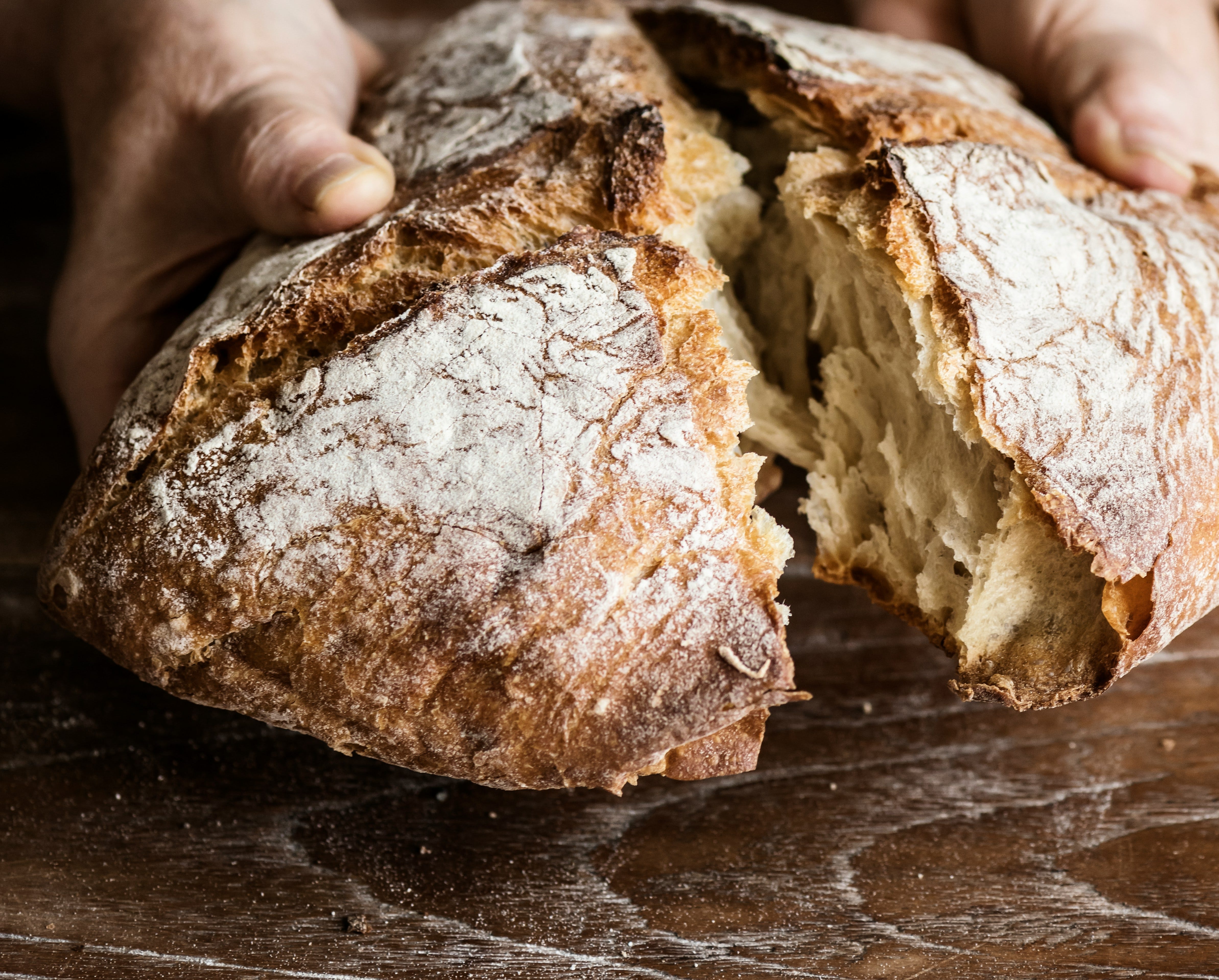
In so many ways, the miracle is a story that Christians know by heart.
He took the bread, blessed it, broke it, and then gave it.
Every Sunday at the Eucharistic table, we perform the same rite: we witness Christ take the ordinary gifts we offer, bless them, break them, and then hand them back to us as the true life of the world. We go to the table not because we have earned enough grace to deserve it, but because we are hungry. We go to the table with empty hands, knowing that God’s open hand gives us more than we could possibly need.
What most impresses me about this story is not merely that food was provided to all of them; they didn’t merely feed everyone in a miraculous manner. After the feeding was completed, twelve baskets’ worth of leftovers were collected. God’s abundance exceeded what was necessary.
It won’t guarantee that God will give us every comfort we desire or every answer we seek in life, but God does promise to provide us with all that we need to carry on with this journey. This may look like bread on the table or strength to make it through the day; it may come from a friend, a priest-mentor, or even a congregation whose gift of generosity allows us to see that we are never walking alone in this life.
I still feel the need to count my lack today, having to remind myself that I am not wise enough, experienced enough, faithful enough, or whatever else I think I need to be if I am going to walk the path in front of me; but then I remember that Jesus never asked the disciples to come to him empty…for that multitude, for me, all he asked was that we come with what we had.
Maybe that’s an invitation that’s been sent out to you and me.
So often this world teaches us to hold tightly onto everything we have in fear that there will never be enough to go around, but the kingdom of God shows us how to trade our fists for hands and allow ourselves to trust because when we put our simplest gifts into the open hand of Christ, they become more than we could have ever imagined or provided by ourselves.
That might be the miracle we need to remember.
That God is enough and his abundance starts as soon as we place ourselves in the hand of Jesus, because he never closes his hand once you’re inside.
Revised Common Lectionary: Proper 13 (Year A) Track 2
Isaiah 55:1–5 • Psalm 145:8–9, 15–22 • Romans 9:1–5 • Matthew 14:13–21
Thank you, Jason. This personal perspective gives me a clearer way to understand the story of Jesus feeding the crowd. Society pushes people yet Jesus tells us that God warmly and graciously welcomes each of us at the Table with plenty to share among each other. Amen! 🙏 😉